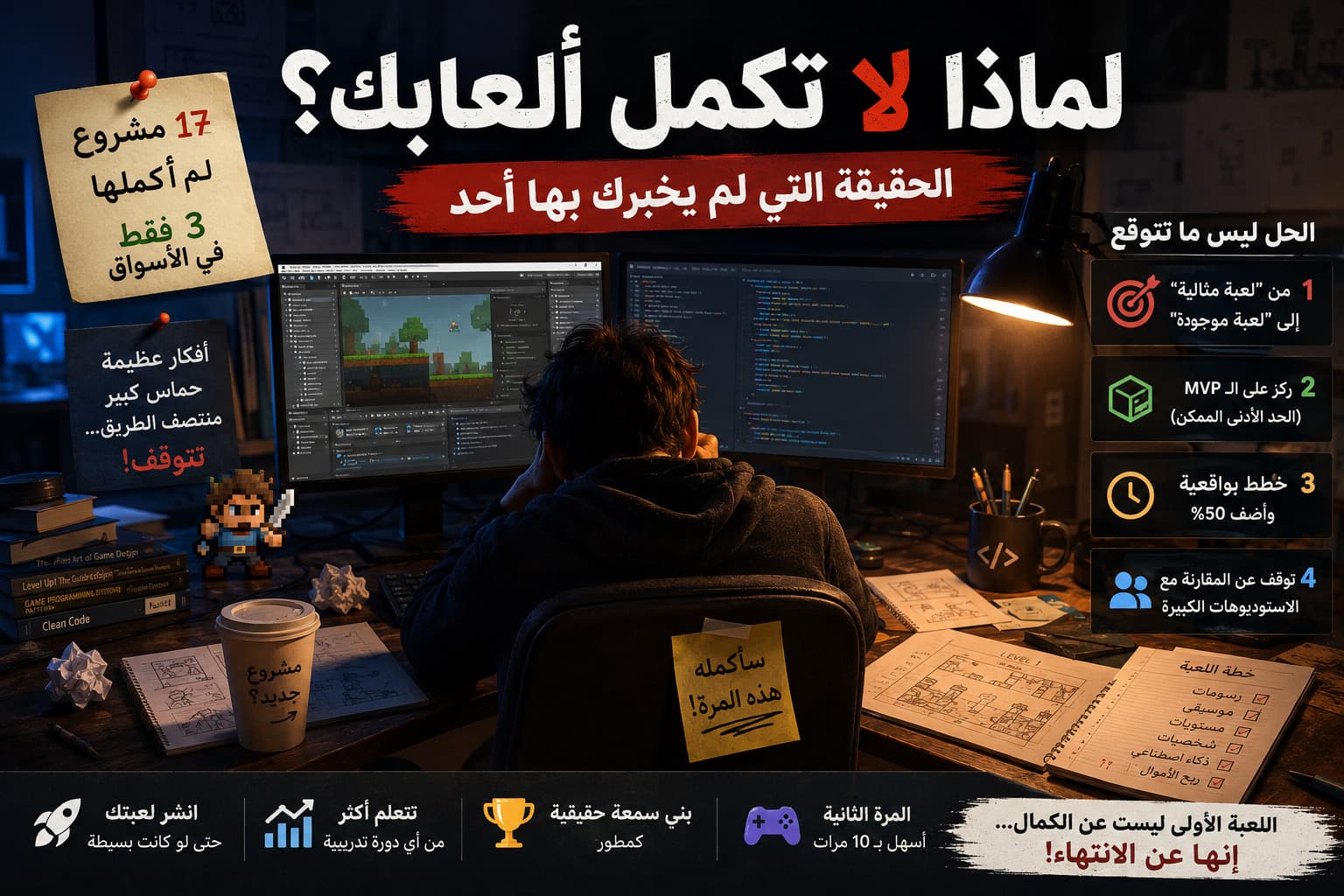

Why You Don't Finish Your Games: The Truth No One Tells You
I was sitting in a small Algerian café a couple of weeks ago, scrolling through my old projects on GitHub, and for the thousandth time in my life, I found myself facing the same painful truth: 17 unfinished projects, and only 1 are on the market.
No, I'm not an exception. You, you, and you—almost 90% of the game developers I know suffer from the same problem. They have brilliant ideas, exciting projects, but they always... always stop halfway through.
And the real question isn't "How do I finish my game?"—the answer is technical and relatively simple. The problem is much deeper than that.
The Trap We All Fell Into
Remember the first day you started your game? The excitement, the energy, the hours of planning, the designs, the vision of how amazing your game would be? You were convinced that this time would be different. This was the game that would make you famous, or at least make you money.
Then it happens.
After a month or two, you start noticing the little things you didn't expect: the graphics are taking longer than anticipated, the core game mechanics are twice as difficult as the calculations suggested, and suddenly your enthusiasm starts to wane.
Then the little developer inside you—that hidden voice—says, "Maybe you should start with a smaller idea first? Just for a little practice?"
Before you know it, you've moved on to a new project.
This isn't a technical failure. This is a psychological pattern.
Why do we do this to ourselves?
The first real reason: We overestimate our capabilities and underestimate the time required.
I personally told myself once, "I can make a simple puzzle game in a month." I ended up taking six months, and even then, it was very simple. The reason? The details. The small details that look simple on paper but take real time to code.
The second reason: We get distracted by tools and techniques instead of focusing on actual productivity.
How many times have you heard yourself say, “I’ll learn C++ first, I’ll choose a better engine, I’ll design a more efficient save system”? All within the first month of a project. This isn’t optimization—it’s clever procrastination. You feel like you’re working hard while you’re just putting off the difficult tasks.
The third reason, and this is the most difficult: Fear of Failure.
You don’t want to ask yourself the big question: “What if I finish the game and no one likes it?” It’s much easier to say, “I abandoned it for technical reasons,” than to face the reality that your creation might not appeal to people.
Numbers Don’t Lie (and My Experience Confirms It)
A study conducted by the University of Gothenburg on 4,000 independent game developers showed that:
- Only 5% of projects in development are actually completed.
- 68% of projects stall in the second quarter of development.
- The actual time to complete a small game is 40% longer than developers expect.
Me personally? Even after completing three games, each one took at least 50% longer than expected.
The solution isn't what you expect (but it works)
I used to think the solution was "be more disciplined" or "work longer hours." But that's another trap.
The real solution starts with changing just one way of thinking:
1. From "Perfect Game" to "Game That Exists"
Instead of creating a perfect game in your mind, create a real game without perfection.
When I started my first game, I wanted beautiful graphics, great music, 50 different levels, and characters with professional voice acting. I would have spent two years on it.
Then I met a Korean game developer who told me something that changed my life: "Finish the ugly game first. Perfection is just a sign of unfinished."
I finished my first game with:
- Very simple graphics (literally, squares of different colors)
- Free music from Incompetech
- Only 10 levels
It took three months. I published it. It wasn't the best, but it was there.
That's better than 100 perfect projects gathering dust in drawers.
2. Your Game's MVP
MVP = Minimum Viable Product. Simply put: What's the bare minimum that makes your game... a game?
For example, a racing game:
- ✗ You don't need 50 maps
- ✓ You need 1 good map
- ✗ You don't need 30 different cars
- ✓ You need 1 car that works properly
- ✗ You don't need a huge studio's graphics
- ✓ You need clear, working graphics
When you focus solely on your MVP, you reduce unfinished projects by 300%.
3. The Realistic, Harsh Schedule
Write it down:
- How many hours per week can you actually work? (Not how many you want—how many you can actually do.)
- How many hours will you dedicate to each feature?
- Multiply each number by 1.5 (for the surprises that always come)
For example, me:
- 20 hours a week (daily work + life)
- A simple game that requires 200 hours (without finishing)
- Result: At least two and a half months
When I accept this from the beginning, I'm not surprised after two months.
4.Stop comparing yourself to big studios
Candy Crush took 10 years to develop. They have a team of 800 people.
You don't need to do that.
You need to do something that's you.
The best game I've made (in terms of profit) was a very vertical game. It didn't win any international awards. Nobody talks about it. But it earned me $15,000 in the first year. And why? Because I finished it while 99 other people didn't finish their games.
Practical Steps That Actually Work
If you're serious about finishing your game:
Week 1:
- Write down your exa MVP (only 3-5 features)
- Calculate the actual time (and add 50%)
- Set a realistic ending
Weeks 2 & 3:
- Stop searching for the "perfect way"
- Start with ugly code if necessary
- Every day: Fix only 1-2 bugs, add one feature
Every month:
- Don't add new features
- Just refine what you have
- Play the game yourself ruthlessly
That's it. Almost.
Final Advice from Someone Like You
Finishing one game is better than ten half-finished projects. This isn't an opinion—it's a fact.
When you publish your game, even a simple one:
- Learn over 100 hours of reading about development
- Build a real resume
- Break the fear of failure
- The second time around is 10 times easier
The first game isn't about perfection. It's about completion.